Concrete looks tough, but it's actually porous — every drop of oil, leaf tannin and mildew spore soaks in and stays. A surface rinse won't touch most of it. Here's what's actually staining your Louisville driveway and what removes it.
Why Louisville driveways get so dirty
Kentuckiana's climate creates several simultaneous staining mechanisms on concrete surfaces. Heavy summers bring algae and mildew growth along shaded edges and under tree canopy. Fall leaves leave tannin stains when wet organic matter sits on concrete through multiple freeze-thaw cycles. Winter road salt and ice melt products leave white residue and accelerate concrete surface degradation. Spring pollen settles into every horizontal surface. And all year long, vehicles drip oil, brake fluid and transmission fluid into the same spots on the driveway.
The result by late spring, after a full Louisville winter, is a driveway that's visibly dingy from a dozen different staining mechanisms — some surface-level, some deeply embedded in the concrete.
What's causing each type of staining
- Dark edges and shaded areas: Mildew and algae growing in areas that stay damp and out of direct sun. This is biological growth, not just dirt — it requires a biocide treatment to kill, not just rinse.
- Black tire scuffs along the wheel path: Heat-transferred rubber polymers from tire friction. These bond to concrete and don't come off with simple pressure — they need hot water and detergent.
- Brown or orange staining: Rust, from sprinklers hitting the driveway with iron-rich well water, from fertilizer runoff, or from metal furniture and equipment sitting on wet concrete.
- Dark drip spots under parking positions: Oil and transmission fluid from vehicles. Fresh oil stains can often be removed almost completely; older, deeply set oil stains may lighten significantly but not disappear entirely.
- Leaf prints and tannin staining: Wet leaves left on concrete deposit tannin compounds that chemically bond to the surface. The longer they sit, the harder they are to remove.
- General gray film: A combination of dust, exhaust, tire residue and oxidation that builds up uniformly across the surface and makes the whole driveway look aged and dull.
Why a regular pressure wand falls short
Waving a pressure wand across a concrete surface leaves visible "zebra stripes" — alternating clean and dirty bands from the uneven pass pattern. Even at high pressure, a wand is concentrating all its force in a narrow stream that you're moving across the surface at walking pace. Some areas get more dwell time than others. The result looks uneven and often worse than before in certain lighting angles.
Professional concrete cleaning uses a surface cleaner — a spinning bar attachment with multiple nozzles that delivers even, consistent pressure across the full width of the machine in every pass. The result is a uniform clean across the entire slab that looks professionally done because it is.
The professional concrete cleaning process
- Pre-treat for specific stains: Oil and grease areas get a hot-water degreaser applied and allowed to dwell before cleaning begins. Rust stains may get an acid-based treatment. Mildew and algae get a biocide pre-treatment.
- Surface cleaner pass: The spinning surface cleaner covers the entire slab at consistent pressure — no tiger stripes, no missed patches.
- Spot treat stubborn areas: Any stains that didn't fully lift get targeted follow-up treatment and a second pass.
- Final rinse and edge detail: Edges where the surface cleaner can't reach get hand-wand treatment, and everything is rinsed clean.
What about oil stains: what can actually be removed?
This is the question we get most often. The honest answer: most oil stains respond well to hot-water degreaser treatment combined with surface cleaning, but results depend heavily on the age and depth of the stain.
- Fresh oil stains (under 6 months): Often lift almost completely with proper degreaser treatment and hot water.
- Established oil stains (6 months to 2 years): Will lighten significantly — typically 60–80% improvement — but may not disappear entirely. The oil has penetrated the concrete pores deeply.
- Long-set stains (2+ years): Will lighten, but the concrete may have permanently absorbed the oil. These often require multiple treatments over time for maximum improvement.
We'll give you an honest assessment of your specific stains during the free estimate walkthrough.
Should you seal your driveway after cleaning?
Sealing is optional but worth considering on newer driveways (under 10 years old) in good condition. Freshly cleaned concrete absorbs sealer far better than dirty concrete — the open pores accept the product and hold it longer. A proper concrete sealer does three things: prevents future oil and stain penetration, protects against freeze-thaw damage, and makes the surface easier to clean next time.
If you're going to seal, do it within 30 days of cleaning. We offer concrete sealing as an add-on to driveway cleaning — ask about it when you call.
What does driveway cleaning cost in Louisville?
A standard two-car concrete driveway typically runs $100–$200. Larger driveways, circular drives, or jobs with heavy oil staining can push higher. Bundling the driveway with a house wash or deck cleaning gets you a better overall rate. Call or text (502) 777-8024 for a free on-site estimate.
Hot water vs. cold water for concrete cleaning
One advantage professional cleaning companies have over rental equipment that most homeowners don't realize: hot water. Hot-water pressure washers — which maintain the cleaning water at temperatures of 130–200°F — dramatically improve results on concrete, particularly for grease and oil contamination.
Hot water breaks down hydrocarbon bonds in oil and grease much more effectively than cold water at the same pressure. The combination of heat, detergent, and pressure produces results on heavily soiled concrete that cold water with detergent simply can't match. Rental equipment is almost always cold water only. Professional-grade hot-water units are expensive and impractical to transport for DIY use.
If your concrete has oil stains, brake fluid drips, or other hydrocarbon contamination, hot-water treatment is the difference between a significant improvement and a near-complete removal.
Efflorescence: the white haze problem
Some Louisville homeowners notice a white or grayish haze on concrete surfaces — on driveways, basement floors, retaining walls, and brick. This is efflorescence: mineral salts that migrate to the surface as moisture moves through concrete or masonry and evaporates. It's not organic growth — it's mineral deposits.
Pressure washing alone won't remove efflorescence. It requires an acidic treatment — muriatic acid, citric acid, or a commercial efflorescence cleaner — to dissolve the mineral deposits before rinsing. This is a service we can include when quoting concrete cleaning; let us know if you're seeing this white haze and we'll assess during the estimate.
Pool decks and pavers: special considerations
Pool decks and paver patios have different requirements than standard concrete driveways. Brushed concrete pool decks need gentle treatment to preserve the surface texture that provides slip resistance — too much pressure can smooth the surface over time, reducing traction when wet. Pavers have joint sand between them that high pressure can erode and wash out, requiring re-sanding after aggressive cleaning.
For both surfaces, we use lower pressure with appropriate detergent, surface cleaners sized for the area, and careful attention to joints and seams. If your pavers need re-sanding after cleaning, we can include that as a service or recommend appropriate polymeric sand products for DIY re-fill.
Stain prevention after cleaning
After a thorough cleaning, there are a few simple steps that extend the time before your concrete needs cleaning again:
- Address active leaks immediately: If a vehicle is dripping oil or transmission fluid, the leak needs repair. No cleaning schedule compensates for ongoing contamination from an active source.
- Move vehicles slightly: If you always park in exactly the same spots, oil and tire residue concentrate in exactly those areas. Varying your parking position by a foot or two distributes wear more evenly.
- Rinse early on pollen days: Louisville's spring pollen is legendary. A quick rinse with a garden hose during peak pollen season washes off the yellow layer before it embeds into wet concrete.
- Clear leaves promptly: Wet leaves left on concrete deposit tannin stains rapidly. Regular leaf removal during fall — especially from sugar maples and oaks, which produce heavy tannin — prevents the most stubborn organic staining.
When to call for a quote
We serve driveways across Louisville, St. Matthews, Prospect, Jeffersontown, Middletown, New Albany, Jeffersonville and the surrounding Kentuckiana region. Most concrete jobs in our service area are scheduled within the same week — sometimes the same day in shoulder seasons.
Call or text (502) 777-8024 or use the quote form on our website. We'll come to the property, look at the actual condition and stain types, and give you a flat-rate quote with no surprises. If there are specific stains you're concerned about — old oil spots, rust staining, efflorescence — point them out on the estimate walk and we'll set honest expectations for what can be removed.
The right expectations going in
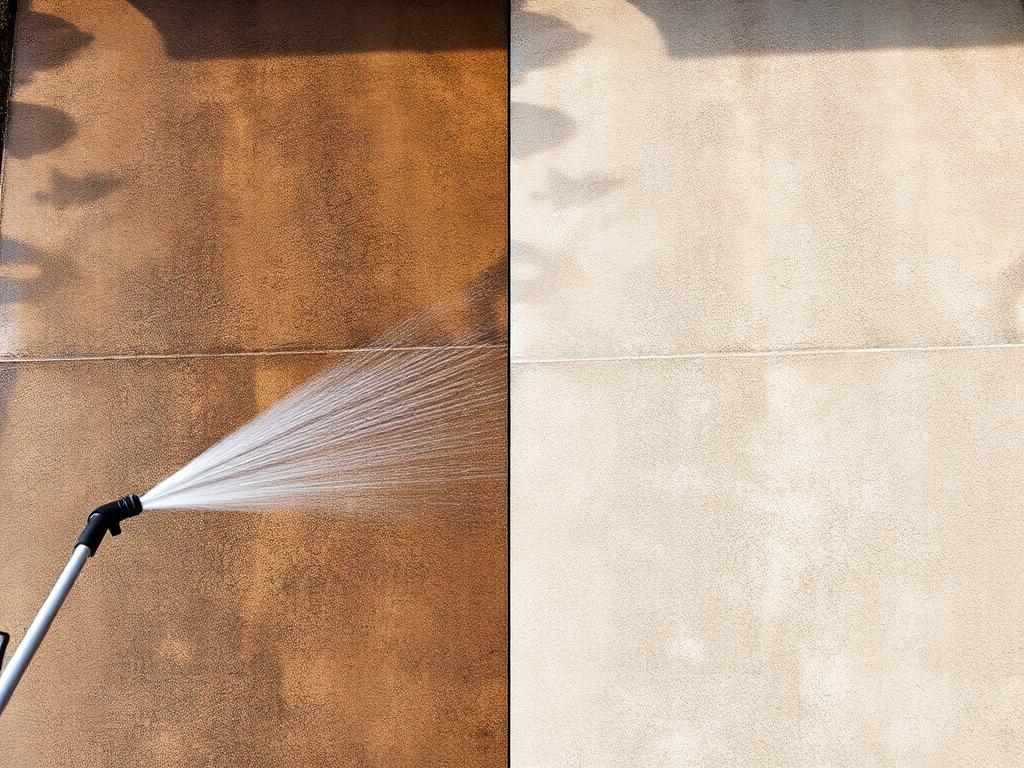
Concrete cleaning is genuinely transformative on most Louisville driveways — the difference between before and after is dramatic and immediate. But some stains are permanent, and we'd rather set that expectation upfront than have you disappointed. Very old, deeply set oil stains, certain rust stains, and any contaminant that has chemically reacted with the concrete at depth may lighten but not disappear entirely. We'll give you an honest read on your specific situation during the estimate visit — no surprises. Call or text (502) 777-8024 to schedule yours.